Protein synthesis
- A two part process in which DNA is decoded into corresponding proteins
- The first process is known as transcription
- The second process is translation
- Occurs in the nucleus and cytoplasm
Transcription
-occurs in the nucleus
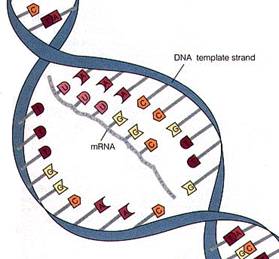
- the process in which mRNA is created by transcribing the DNA’s code
-the enzyme RNA polymerase temporarily unzips DNA and adds complementary RNA nucleotides to the growing mRNA strand.
DNA strand: TAC CCA GGA GCT TAT ACT
mRNA strand:
*mRNA is always complementary to DNA!
mRNA is single stranded so it can simply exit the nucleus via nuclear pores (DNA is too large to exit).
Translation
-a process in which the mRNA that was previously manufactured is translated into an amino acid sequence (proteins)
-occurs in the cytoplasm, on the ribosomes
-involves all types of RNA
mRNA strand: AUG GGU CCU CGA AUA UGA
tRNA strand:
*tRNA transfers amino acids. The amino acids are attached to the tRNA via a specialized enzyme called tRNA synthetase
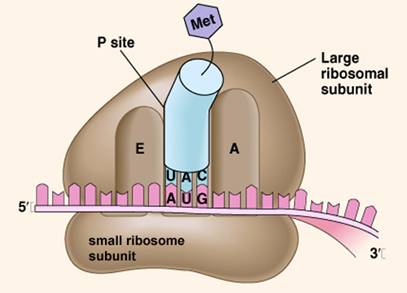
-Met is the amino acid methionine
-The ribosome location at which tRNA binds to is known as the P-site (peptidyl-tRNA site)
-The A-site is awaiting the next tRNA + amino acid complex
-As the polypeptide chain grows, the ribsome moves towards the 5’ end of the mRNA, and the tRNA moves to the Exit site, or E-site, where it then detaches itself, leaving the amino acid at the ribosome.
Reading codons
-there are 61 different codons which represent the 20 amino acids as well as start and stop signals (start codons= AUG; stop codons= UAA, UAG, UGA)
-All codons between the start and stop codons are known as “exons”, all codons outside the start and stop codons are called “introns”.