Energy Flow in Ecosystems
Ecologists study how energy moves
through an ecosystem by assigning organisms in that ecosystem to a specific
level, called a trophic level, based
on the organism’s source of energy.
Energy moves from one trophic level to another.
The path of energy through the trophic levels is called a food chain. The lowest trophic level is is occupied by the
producers, which use energy from the sun to build carbohydrates.
At the second trophic level are herbivores, animals that eat plants and
other types of producers. An herbivore msut be able to break down a plant’s
molecules into usable compounds. Plants have a tough layer of cellulose, which
only a few herbivores are capable of breaking down. Most herbivores rely on
mircoorganisms, such as bacteria, in their gut to help them digest cellulose
(humans do not have this in their system).
The third trophic level are secondary
consumers called carnivores, animals
that eat herbivores. Animals that are both herbivores and carnivores, such as bears,
are called omnivores. They use
simple sugars found in plants, but cannot digest the cellulose.
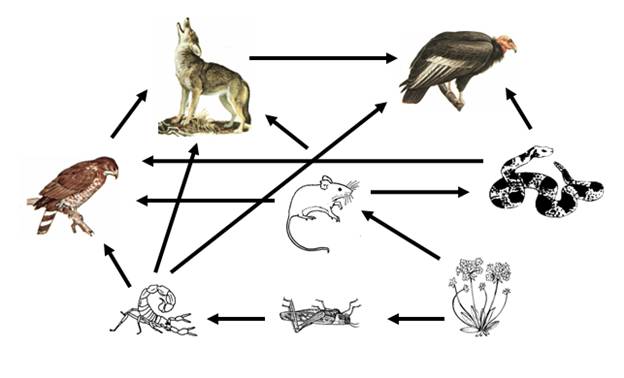
1. Label one producer, one consumer and
one decomposer on the food chain above.
2.
Write
a food chain in which the hawk is a secondary consumer:
3.
Write
a food chain in which the hawk is a tertiary (3rd) consumer:
4.
Which
trophic level is NOT shown in the food web above?

5.
Which organism is gaining the most energy in
this pyramid? ________________
6.
Which organism is gaining the least energy in
this pyramid? ________________
7.
How much energy is available to the snake? ___________________________

8. Approximately how much energy is available to the secondary
consumers in this energy pyramid?
A. 10
kcal/m2/year
B. 100 kcal/m2/year *
C. 1,000
kcal/m2/year
D. 5,000 kcal/m2/year
For numbers 1-8, write “1” if the clue
describes the first trophic level, “2” if it
describes the second trophic level, and “3” if the
clue describes the third trophic level.
_____1. Primary consumers are found here.
_____2. Organism here use
energy from the sun to build energy-rich carbohydrates.
_____3. Tigers, wolves, and snakes would be
found here.
_____4. Organisms here are capable of
breaking down cellulose.
_____ 5. Secondary consumers are found here.
_____ 6. Plants, algae, and bacteria are found
here.
_____ 7. Humans would be found at this level.
______8. Organisms here rbeak down a plants into usable compounds.
______ 9. Which of the following is NOT an
example of a primary consumer?
A.
Maple
trees
B.
Caterpillars
C.
Cows
D.
horses
10. How are carnivores and omnivores
alike? How are they different?