Description
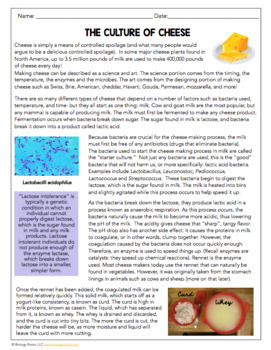
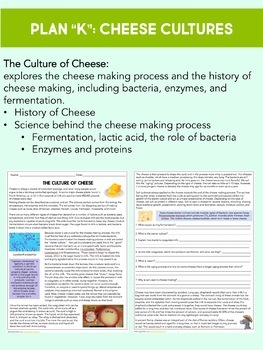
This covers the fascinating process of cheese making and relates it to scientific processes! Kids will never look at cheese the same! This literacy resource ties in fermentation and enzymes.
This resource explains the cheese making process while incorporating the science behind it. It also includes some fun facts and ties in biochemistry.
Included in the resource you will find:
❀ Coagulation
❀ Fermentation
❀ Enzymes
❀ Proteins/amino acids
❀ Proteolysis
*Class Packet option included to save paper.
Please note that is this is designed to cover one 50 minute class period. It is not a front and back sheet of paper; but rather more comprehensive and engaging.
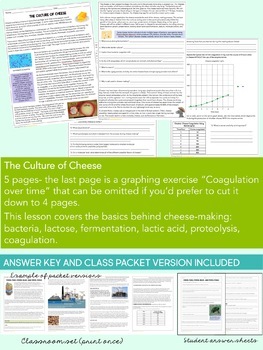
There is also a graphing exercise on the last page in which students graph coagulation with the use of enzymes.
This sub plan is a useful tool to help encourage scientific literacy in reading, graphing, and making connections to the scientific world.
Here is a snippet from Sub Plan K:
“As the proteins deconstruct, they become large chains of amino acids (polypeptides) that further separate into smaller chains (peptides). Peptides provide cheese with its distinct flavor, based on the configuration of these amino-acid chains. Different flavors of cheeses have been described as buttery, woodsy, nutty, “mushroomy”, or “animally” tastes. These different tastes and textures are a result of this intricate chemical process. The other expelled elements from the casein also contribute to flavor and texture. Calcium neutralizes acidity, and released water creates moisture.”
Feel good knowing that your students will be well taken care of on those days that you are out- don’t scramble for another sub plan! You can use this year after year!
As with most of my sub plans, this can be easily reduced to 4 pages by omitting the last page.
Recommended for grades 7+
Answer key included (as always)
✿ ❀ Buy Bundled and Save!✿ ❀
This sub plan can be found in the following bundles:
Emergency Sub Plans Volume III
Secondary Science Sub Plans: Super Bundle
Plus, when you buy bundled, not only do you save $$, but you cover more time and you cover your you-know-what by being extra prepared with FIVE or FIFTEEN activities. The bundles also come with bonus documents to include for your sub!
——————————————————————————————-
You May Also Be Interested in the Following Individual Sub Plans Available:
Cancer Sub Plan
An inside look that explains how cancer forms. Science literacy and graphing.
Nerdbook: Social Media Biography
Students design a Facebook page using the biographies and templates included. Rubric is also included.
Nutrition Labels and Macromolecules
Explores fats, carbs, proteins, and how they add up on nutrition labels. (Reading, matching, and minor math {multiplication and addition}).
Sub Plan- the Effect of Video Games on Your Brain– this activity takes a nontraditional spin on video games. It is based on evidence created in the lab of Daphne Bavelier.
Sports Injuries Sub Plan
Explores common sports injuries (fractures, sprains, strains, swelling and and bruising. (Reading, matching and graphing).
❀Sub Plans A-E can be found in a mini bundle of 5 sub plans: Sub Plans Volume I (A-E)❀
————————————————————————————-
Fossil Fuels Sub Plan
Explores the use of fossil fuels and the ramifications of using them. Students read, answer questions, and analyze a chart.
Vaccines Sub Plan
Students learn all about the smallpox pandemic, and how Edward Jenner, James Phipps, and a milkmaid named Sarah were all heroes in coming up with a way to prevent this deadly virus. Optional timeline included for a multiple day absence.
Radio Waves Sub Plan
Generation Y relies heavily on radio waves for their Wi-Fi, cell phones, and video games. This explains radio waves, how radios work, and how cell phones work. Students analyze a pie chart about cell phone use.
Immune System Sub Plan
Students read this condensed version on the mystifying (and awesome) world of the immune system. In doing so, they gain a better understanding of allergies.
Genetically Modified Organisms
Students read this unbiased article about the construction and use of genetically modified organisms. Students answer questions within the text, and at the end are asked more ethical questions.
❀Sub Plans F-J can be found in a mini bundle of 5 sub plans: Sub Plans Volume II (F-J):❀
—————————————————————————————–
Enzymes and Fermentation
Students explore the history and the science behind the cheesemaking process, specifically on enzymes and fermentation.
Scientific Method
This takes a non-biased, psychological spin on Big Foot’s suggested existence and why it is so important that we use the scientific method. Students form an experiment trying to lure Big Foot with apples.
Vector Diseases: Mosquitoes
Students explore the mosquito and vector-borne diseases. Two version are included with this sub plan: an original version that introduces students to bar graph breaks when working with a wide range of data, and a graph-free version that omits the graph and includes a couple extra analysis questions.
Solar Power Sub Plan
Students are introduced to the history of fossil fuel use going all the way back to Rockefeller, how it has affected our environment. Students explore how solar power: how it works and why it is a cleaner and more efficient alternative to fossil fuels.
Antibiotics Sub Plan
Students are introduced to the history and science of antibiotics, and how they are evolving to form superbugs such as MRSA.
❀Sub Plans K-O can be found in a mini bundle of 5 sub plans: Sub Plans Volume III (K-N)
———————————————————————————————-