Description
These cells activities are organized into a supplementary journal, as an easy way for students to get engaged with cells using inquiry and models – which prepares them for their cell unit!
In the classroom, the cells inquiry journal is called inquiry journal (Analyzing and Thinking Like a Scientist): a model based learning journal developed to emphasize real world science without route memorization, making it easy to incorporate modern biology frameworks such as NGSS during your cells unit.
How to use the Cells NGSS Inquiry (inquiry journal) Journal: First, read the teacher guide so that you know what is expected of the students, as well as any materials you may need.
For the most inquiry based learning, have students complete it before teacher instruction. You know your students best; after reviewing the teacher guide you may decide to skip certain activities in the cells inquiry journal, and instead save them for teacher instruction. This order also supports NGSS pedagogy.
Once the inquiry journal is complete, move on to teacher-lead instruction (this material is not included).
Simplified Cells Inquiry for NGSS: Inquire, Engage, Explore!
CELLS INQUIRY JOURNAL OUTLINE: Big Idea, Build It, Explore It
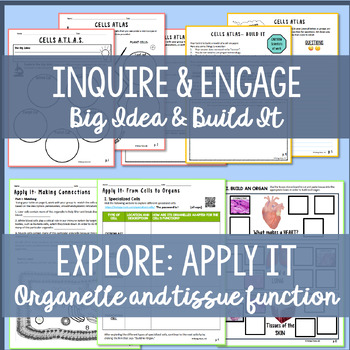
Students inquire about the “Big Idea”: cells are the basic unit of structure and function in all living things; and then move on “Build It” in which students work in groups to come up with a cell model. There are NO wrong answers in the inquiry journals!
MAPS are the exploratory portion of the cells inquiry. Included are the following:
1. Model It: Explore and Build a Cell students hop online to look at cells in more detail, learning about organelles and levels of organization
2. Apply It: Making Connections Students are introduced to the Class Cell-fie, in which a model is built as students label their respective model in their journal.
4. Apply It: Mystery Cell Students learn about different functions at the cellular level and how its related to specialized tissues; Build an Organ is a cut and paste in which students deduce which tissues make an organ.
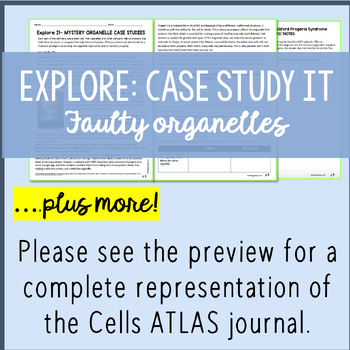
5. Case Study: Hutichinson-Gilford Progeria Syndrome 3 page case study that explores the diagnosis of a girl named Ella; students try to determine the faulty organelle.
Optional Materials: microscopes and slides (if available)
FAQ:
1. Will this work with my current teaching materials?
- Absolutely! This is an easy way to incorporate modern science frameworks such as NGSS into any classroom, and will work with any existing teaching materials. For genuine inquiry, give it to your students before you teach your typical unit. Or you can pick and choose certain activities to use to support model based learning.
2. Is the inquiry journal a complete unit? Does this replace my teaching unit?
- No, the inquiry journal is a supplement to your teaching materials. The journals take approximately 3-4 classes to complete. It is designed for your students to complete before teacher-lead instruction. The teacher-lead unit materials are not included, but you can use the inquiry journals with whatever teaching materials you currently use.
3. Will my students be more prepared for the topic I teach after using the inquiry journal?
- Yes, it is tried and true inquiry or model based learning, which studies have shown result in greater retention and understanding of the phenomena.
4. Does it only work for states that have adopted NGSS?
- No! Any classroom can use these activities. It is simply guided inquiry/ model based learning.