Description
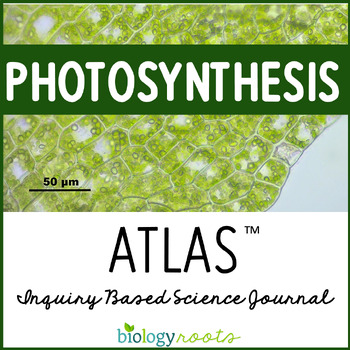
This photosynthesis science journal is an easy way for students to get engaged in the content using inquiry and models!
The inquiry journal (Analyzing and Thinking Like a Scientist) journals are a simplified 5E structure designed to complete before teacher-lead instruction (plug and play). This is for ANY curriculum.
inquiry journal model based journals were developed to emphasize real world science without route memorization, making it easy to incorporate modern biology frameworks such as NGSS, while offering flexibility in the classroom.
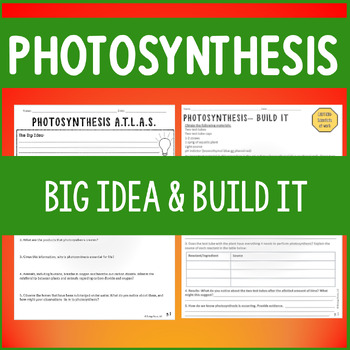
PHOTOSYNTHESIS INQUIRY JOURNAL OUTLINE: Big Idea, Build It, Explore It
Students inquire about the “Big Idea”: photosynthesis is the conversion of light energy to chemical energy; and then move on to a condensed version of the photosynthesis with pH indicators. There are NO wrong answers in the inquiry journals!
MAPS are the Exploratory portion of the journal. Included are the following:
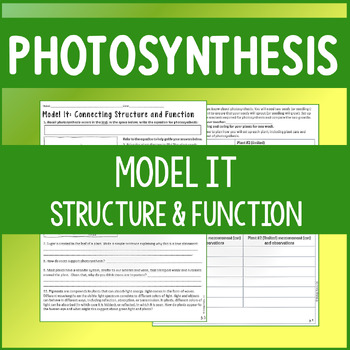
1. Structure and Function Model: students connect plant structure to its function regarding photosynthesis; student designed lab tests a control against a limited reactant of photosynthesis.
2. Predict: students learn about wavelengths of light and use an online model to predict which colors of light plants thrive best in.
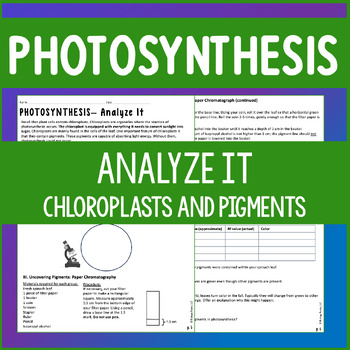
3. Analyze: Students learn about chloroplasts and pigments; complete a chromatography lab to visualize
4. Case Study: Students learn about deforestation in the Amazon forest, and how it ties into photosynthesis and climate change.
5. Simulation: Students learn about energy carriers and ATP, a short introduction to light dependent and light independent reactions, and energy transfer. Students can build a simple Rube Goldberg machine to simulate.
Suggested Materials: test tubes, phenol red or BTB, aquatic plants (list of suggested ones included in download), seedlings, light source, plastic cups and soil, plastic wrap, spinach leaves, rubbing alcohol, coins, filter paper or chromatography paper
FAQ:
1. Will this work with my current teaching materials?
- Absolutely! This is an easy way to incorporate modern science frameworks into any classroom, and will work with any existing teaching materials. For genuine inquiry, give it to your students before you teach your typical unit. Or you can pick and choose certain materials to use to support model based learning.
2. What do I need to use the inquiry journal?
- Chromebooks or student devices are used for a small portion of the inquiry journals. Additional materials, such as lab supplies, are found in the teacher guide. These materials support the hands-on activities, but can be modified.
3. Is the inquiry journal a complete unit? Does this replace my teaching unit?
- No, the inquiry journal is a 7-12 page journal that takes approximately 3-4 classes to complete. It is designed for your students to complete before teacher-lead instruction. The teacher-lead unit materials are not included, but you can use the inquiry journals with whatever teaching materials you currently use.
4. Will my students be more prepared for the topic I teach after using the inquiry journal?
- Yes, it is tried and true inquiry or model based learning, which studies have shown result in greater retention and understanding of the phenomena.